
Cedric enjoys rolling in the grass while Edith looks for a snack

We continue our research into the proteins that dogs (and humans) eat. There’s a lot of noise on hormones and medicines given to industrially raised chickens and eggs. What does the research say? How worried should we be? We dug into the literature to find out.
.
Chicken anyone?
**TLDR: Chicken is a great addition to a varied canine and human diet. In the US and Europe all chickens are hormone-free by law. Antibiotics are fed to chickens, but the amounts are low and rules require washout periods, making it unlikely to be an issue for you individually (society is another story however, see below). Pasture-raised chickens and eggs have a better fatty acid profile (omega-3s and PUFAs), but if you’re on a budget, go for the freshest regular stuff. Fatty acids can be made up with fish oils and other fats.
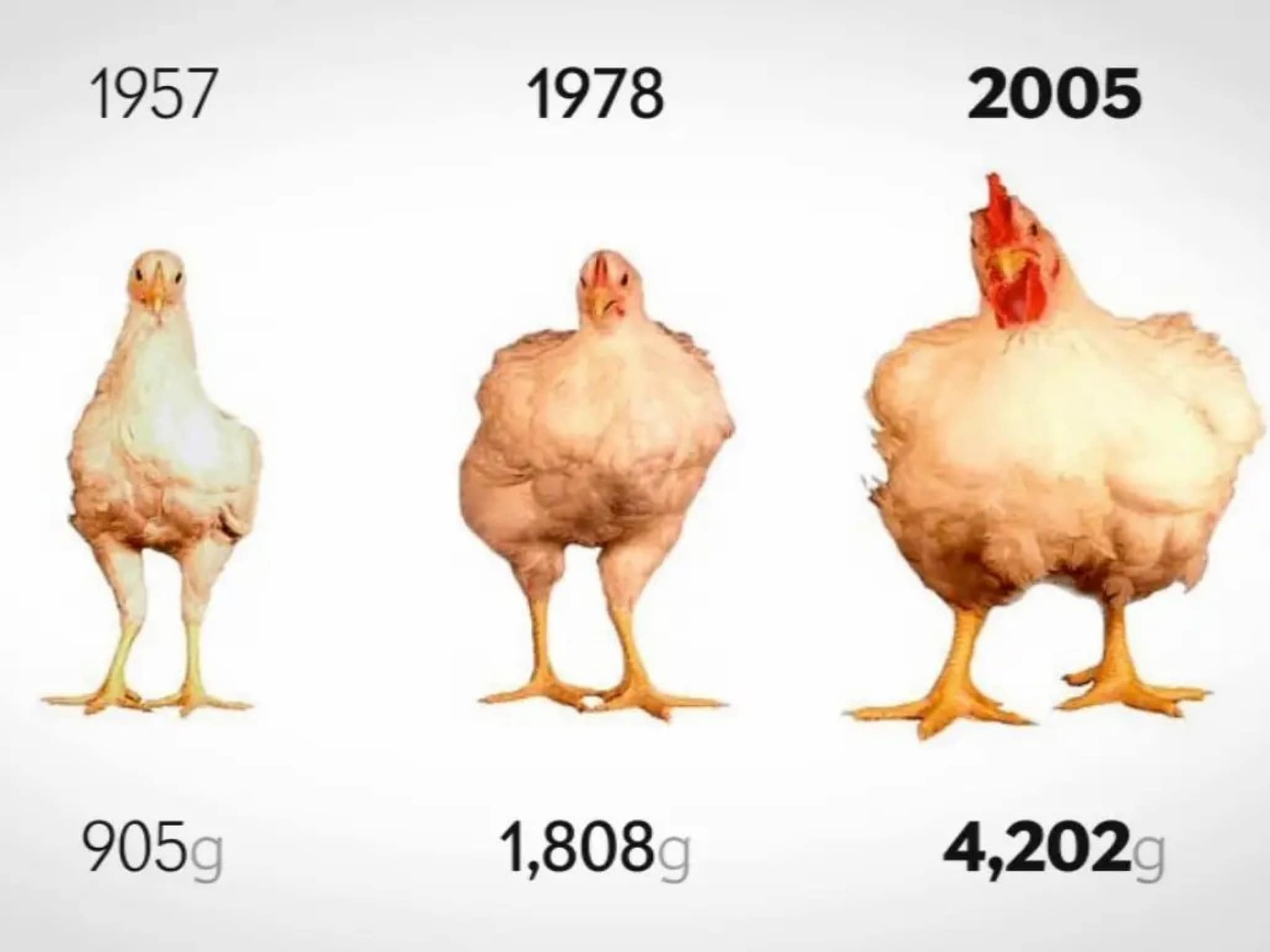
The average chicken has more than quadrupled in size since the 1950s. It’s easy to think that hormones are responsible for the increase; after all, bodybuilding has had a similar trajectory, fueled by steroid use. However, the reality is that hormones have been banned in poultry production in the United States since the late 1950s.
The skeptical minded might think that cheating exists, and of course, it is always possible, but there are stringent testing protocols to ensure food safety. Furthermore, the most efficient way to administer hormones is through injections. Given that the average commercial chicken farm has over 100,000 birds, injections on this scale are just not cost-effective.
Some brands advertise their chickens as being hormone-free, which is technically true. But we find the practice to be distasteful because it implies that other chicken might contain hormones when, in fact, all chickens in the US and EU are hormone-free by law.
Why are chickens so big today?
Unlike people, livestock can be selectively bred for size. Over decades, farmers and livestock producers choose larger and faster-growing chickens for breeding stock. This selective breeding coupled with improvements in farming conditions and improved feed quality is responsible for the massive increases in size.
What about antibiotics?
Antibiotics also play a role in increased size. Farmers add antibiotics to food in low doses to improve feed efficiency, gut health, and prevent diseases. Given the lower doses, strict guidelines, and routine testing in poultry farming, antibiotic residues in our food supply are generally not a concern. For example, a person might take a 500 mg dose of antibiotics, but the amount in any given tissue during this time is a small fraction of that. Additionally, FDA guidelines require a washout period before chickens are processed for food.
**Antibiotic resistance **
Antibiotic resistance occurs when certain bacteria evolve to survive even large doses of antibiotics, posing a major threat to public health. Since over two-thirds of the medically important antibiotics used in the U.S. are for industrial farming, livestock remain one of the main drivers. Today more than 95% of Staphylococcus aureus strains (bacteria that cause infections) are resistant to penicillin, despite penicillin being widely used for less than 80 years.
Researchers are concerned with the speed at which bacteria are developing resistance to antibiotics, and estimate that more than 70% of disease causing bacteria are resistant to at least one commercially available antibiotic. According to the WHO, antimicrobial resistance is among the top-10 global public health threats facing humanity. Antibiotic-resistant infections are estimated to claim up to 10 million lives per year by 2050, and inflict $100 trillion in damages. Resistance is growing and further exacerbated by the shortage of new antibiotics in development.
In May of 2024 the FDA issued new guidelines to change the status of many antibiotics from over-the-counter (OTC) to requiring prescriptions from veterinarians, but this is unlikely to stop the trend. Ultimately antibiotic resistance is a complex threat with no easy solutions.
What about pasture raised chicken and eggs?
The literature on pasture-raised chicken and eggs is diverse and reflects the complexity of scientific research. Some papers, like this one, show no difference in meat quality and macronutrients between pasture-raised and conventionally raised chickens. Other papers, like this one, highlight significant differences in fatty acid composition. Similarly for eggs, some studies report that pasture raised eggs are of lower quality and freshness compared to conventionally raised eggs.
However, this study compared three types of eggs: conventional cage-free eggs, commercially available pasture-raised eggs and eggs fortified with pasture raised beef by-products. The conclusion was that eggs from chickens fortified with beef farming by-products were nutritionally superior, while the pasture raised eggs were nutritionally superior to conventionally raised eggs. Specifically, nutritionally superior eggs had lower saturated fats and higher polyunsaturated fats (PUFAs) with more omega-3.
So what’s the deal?
The reality is that a chicken’s access to pasture probably doesn’t materially affect the quality of the chicken or the eggs. What’s most important is what the chickens eat, the care they receive and how fresh the products are when consumed. In other words, the pasture only matters if there are critters and vegetation for the chickens to forage, adding diversity to their diet.
Today, there is so much marketing and misinformation that it’s difficult to know exactly what the chickens are eating and how they are treated. For ourselves and the pups, we sometimes buy more expensive eggs and chicken, assuming that a higher price means better food and treatment. However, since the main difference is in the fat profile rather than the macronutrient profile, if you want to save money, go for cheaper options. Fatty acid ratios can be easily adjusted with fish, fish oils, and healthy fats like olive oil.
Chicken allergies
As we’ve covered in a previous article, food allergies in dogs are less common than most people believe. Environmental irritants are often mistaken for food allergies. Even though it is rare, chicken is one of the foods that can actually cause allergies in dogs. We once thought Cedric was allergic to chicken because he had a mystery rash on his ear. But after isolating for just chicken, we found that it wasn’t actually the chicken causing it. We never figured out the exact cause, but it was likely an environmental trigger as it hasn’t come back.