

We recently took the dogs on a short beach vacation. They had a blast running on the sand. It was cold but beautifully sunny!

Recently we’ve come across concern about sea kelp (A. nodosum) being dangerous. One person emailed us saying their vet said sea kelp causes thyroid disease and to avoid it entirely. Research is hard, and most people, even professionals that work in a particular field, may not be up to date. Since we love sea kelp, we wanted to get exact and give you the most up-to-date details.
Sea kelp TLDR:
Despite reports to the contrary, sea kelp is a wonderful supplement for dogs, especially those who are fed home made diets. However, dental products containing sea kelp might be dangerous as the recommended doses of these supplements leads to high amounts of iodine for small dogs. Also, because AAFCO’s upper limit for iodine is higher than what the research suggests is optimal, feeding sea kelp alongside commercial dog food could be dangerous, especially for dogs with metabolic or thyroid issues. Over time, very high doses of iodine can lead to permanent damage to thyroid function. But some studies suggest that iodine from seaweed is different. Ultimately we play it safe and just brush the dogs’ teeth.
What is sea kelp for?
As most of you may know, we prefer to get all of our nutrients through whole foods if we can. However, supplements are helpful, especially for harder to get minerals like magnesium and calcium. Iodine is particularly difficult to get from terrestrial foods and is added to table salt in America. Since we don’t give iodized salt to the pups, our main source for their iodine is sea kelp. We also use it in our All-Pups Seasoning and Pup Pot Meals. We think it’s great as a natural source of iodine and many other minerals. In fact sea kelp is such a good source of iodine that we only use trace amounts (less than 1%) in our Pup Pot Meals.
Like with most good things, more isn’t always better. Vitamin D, vitamin A and even water can be toxic for dogs in large amounts. Iodine can cause issues in small amounts, but vertebrates (e.g. fish, birds, reptiles and mammals) have an organ called the thyroid that uses most of the iodine and can help regulate iodine levels. When a dog eats food with excessive iodine levels, the thyroid can shut off parts of its function in order to prevent overproduction of thyroid hormones. However, long-term high doses of iodine can lead to permanent damage. More on that below.
AAFCO Iodine requirements
As we’ve discussed many times in this article, we think AAFCOs requirements often don’t make sense. From too little protein, to not enough fat and too much carbohydrate, AAFCO is made for manufacturing convenience and not optimal dog health. The requirements for iodine, particularly the allowable upper limit of iodine, could be too high.
Although there are not many high-quality studies on the upper limits of iodine in dogs, we found one small controlled study of iodine’s affect on growth. Using x-rays and bone scans, researchers found that commercial dog food and homemade food with 5.6 mg / kg potassium iodide (roughly equating to 4.3 mg / kg iodine) significantly impacted bone and cartilage growth from hypothyroidism. Considering that this is well below AAFCO’s maximum of 11 mg / kg for iodine, it’s possible that commercially available foods within AAFCOs limits could cause thyroid problems. This is especially important for puppies as they consume 2-3 times more calories than adult dogs of the same weight.
What does the thyroid do?
The thyroid gland makes thyroid hormones that help to regulate metabolism. These hormones affect the function of most of the systems in the body including heart rate, body temperature, activity levels, growth and more. Iodine is such an important component of thyroid hormones that T3 means that the hormone contains 3 iodine atoms and T4 means that the hormone contains 4 iodine atoms.
When animals get too much or too little iodine, the production of these hormones is affected, sometimes in unpredictable ways. For example, too much iodine can lead to hyperthyroidism where the thyroid produces too much T3 and T4. Conversely, it can also lead to hypothyroidism where the thyroid slows down in response to too much iodine and reduces hormone production. In some cases there is a sequence of hyperthyroidism before hypothyroidism.
Small amounts of sea kelp daily are great, but larger amounts could be harmful.
In recent years a number of products began using sea kelp as a dental supplement because some small studies showed benefit to reducing tartar on dogs’ teeth. The original studies called for 500 mg of sea kelp daily, which is too much for smaller dogs. More recent doses are lowered to 330 mg per day for dogs up to about 25 pounds, which is likely still too high for little ones.
Also, because of variability of natural plants, the levels of iodine can vary significantly. According to the Center for the Study and Valorization of Algae (CEVA), A. nodosum averages 68.5 mg of iodine in every 100 grams, and can contain between 36 mg and 177 mg of iodine per 100 grams. The highest concentration can be about three times more potent than the average.
Since dogs are often fed the same supplement for months at a time, if you happen to get a very potent batch, it will exposing your dog to high amounts as long as you continue with the same batch.
If we use Edith as an example, she only gets about 500 mg of sea kelp per week. If she took the recommended 500 mg daily dose of sea kelp for dental health, she would be increasing her iodine intake by about 8-times with only average levels of iodine in the sea kelp. If the batch of sea kelp were to be very high in iodine, she could be getting over 20-times her daily recommended dose of iodine.
Is your dog at risk for too much iodine?
Most dogs that consume excessive levels of iodine will experience some hormonal issues. Yet some dogs are more sensitive to iodine than others. Studies suggest that some breeds like Giant Schnauzers and Beagles are most susceptible. Metabolic disorders, obesity, old age and other illnesses can affect the adaptability of a dog’s thyroid glands. Chronically high iodine can cause permanent damage and impact the production of thyroid hormones for life.
Sea kelp supplements now offer lower doses for small dogs (330 mg of sea kelp per dose), but increased doses for larger dogs. If their daily food is also high in iodine then the risk increases. This is also why we say not to put All-Pup Seasonings on commercial dog food, even though the amount would be far lower than a dental sea kelp supplement in most cases.
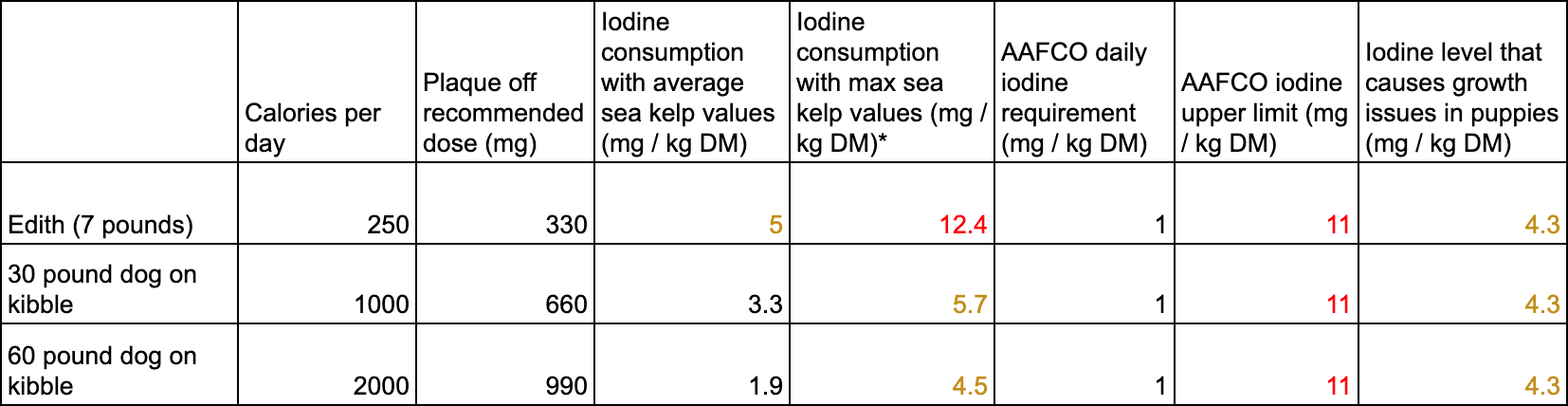
The table above normalizes all figures to mg of iodine per kg of dry food for easy comparison. However, it’s not a direct comparison because puppies consume 2-3 times the amount of calories as adult dogs per kg of body weight, so their overall consumption of iodine is higher. Also, other papers suggest that the puppies that had growth impacted were overfed, further increasing iodine intake, so that value is yellow rather than red.
Another aspect of iodine from sea kelp is that it appears to be less bioavailable than inorganic forms such as potassium iodide. According to this meta-analysis brown sea kelp is bioavailable at 40% maximum, compared to potassium iodide which has over 96% bioavailability. However, the meta-analysis was done on human studies, and is only illustrative for dogs.
Ultimately, the risk for developing thyroid issues is highest when feeding small dogs big doses of sea kelp while also feeding a commercial diet. Most dosing regimens don’t scale linearly. For example, a 330 mg dose for Edith would be almost 3 g of sea kelp for 60 pound dog, which none of the supplements we surveyed recommend.
We play it safe with sea kelp, keeping doses low, and just brush the dogs’ teeth and give them chew sticks.
Read labels and choose carefully
Because pet products are not actively regulated by the FDA, USDA nor AAFCO, the responsibility to adhere to regulations is generally at the discretion of manufacturers. Unfortunately, not all manufacturers are good stewards of public trust. Hill’s, the manufacturer of Science Diet, had multiple class action suits against them for deceptive marketing tactics. The claims ranged from working with researchers to disparage grain-free foods (Erroneously publishing papers linking grain-free foods to Dilated Cardio Myopathy) to marketing regular foods as requiring prescriptions, despite having no pharmaceuticals in them.
It’s up to consumers to be informed and choose wisely. You can get comfortable reading labels, or if you’re familiar with using AI tools you can simply copy and paste ingredients into your favorite LLM and ask questions about them. Keep in mind ingredients are listed from most to least, so if you’re looking at a food, sea kelp should be the last ingredient like in Pup Pot Meals.